



 48 / 154

THE MARKET
The entire Wraps, Bags and
Foil market is worth A$273
million a year inAustralia. It
consists of two categories,
Food Management and
Disposal Management. Of
these, Food Management is
by far the larger. It is worth
A$185 million, whereas
Disposal Management is
worth a total ofA$88million.
Of this entiremarket, 75%
value share ismade upof five
key sub-categories, namely
plastic wrap; foil wrap;
garbage bags; reclose bags;
and kitchen tidy bags.
GLAD is the market leader
with a 32% value share.
As part of their normal
shopping pattern, 93.5% of
Australian households
purchase some kind of product from this market.
For some time, this number has been increasing
steadily as the time saving and convenience
benefits have become more widely appreciated by
people living busy lifestyles.
ACHIEVEMENTS
GLAD is a household name in Australia,
synonymous with quality and freshness.
GLAD has been the leading brand in this
category since the brand’s launch – in 2006, the
brand celebrated 40 years of providing Australian
households with products designed to improve
hygiene, tomake life easier around the home and to
save time.
In that time, the GLADproduct range expanded
to encompass more than 20 convenient products
in theAustralian market. GLAD SteamLock Bags
are the latest addition to the GLAD product range.
Introduced in 2006, this product has created a new
segment in the Wraps, Bags and Foil category.
HISTORY
The GLAD brand originated in the USA when
Union Carbide Corporation launched GLAD
Wrap in 1963. After extensive market research,
both GLAD Wrap and GLAD Bags were
launched in Australia by Union Carbide in
September 1966.
Market research into the lunchwrapmarket in
Australia showed that 60% of consumers used
greaseproof paper and 40% used
waxed paper for lunch wraps. In
addition, 65%of wrapped lunches
were thenwrapped again in paper
bags and 20% in plastic bags. It is
not difficult to see why the
concept of a ‘see-through’ wrap
which would cling to itself and
take the place of all of those
products was well received by
Australian women.
In order to generate publicity
for the launch, functions were
planned in both Sydney and
Melbourne to which local
columnists, women’s magazine editors, retail trade
leaders and social identities were invited. The host
of these functions was Graham Kerr, the country’s
best-known food expert at the time.
Guests were invited to take part in a
demonstration by trying to tell the difference
between food prepared andwrapped inGLAD three
days before, and food
prepared that day. To keep
the test honest and to
increase
the
newsworthiness of the
events, the wrapped food
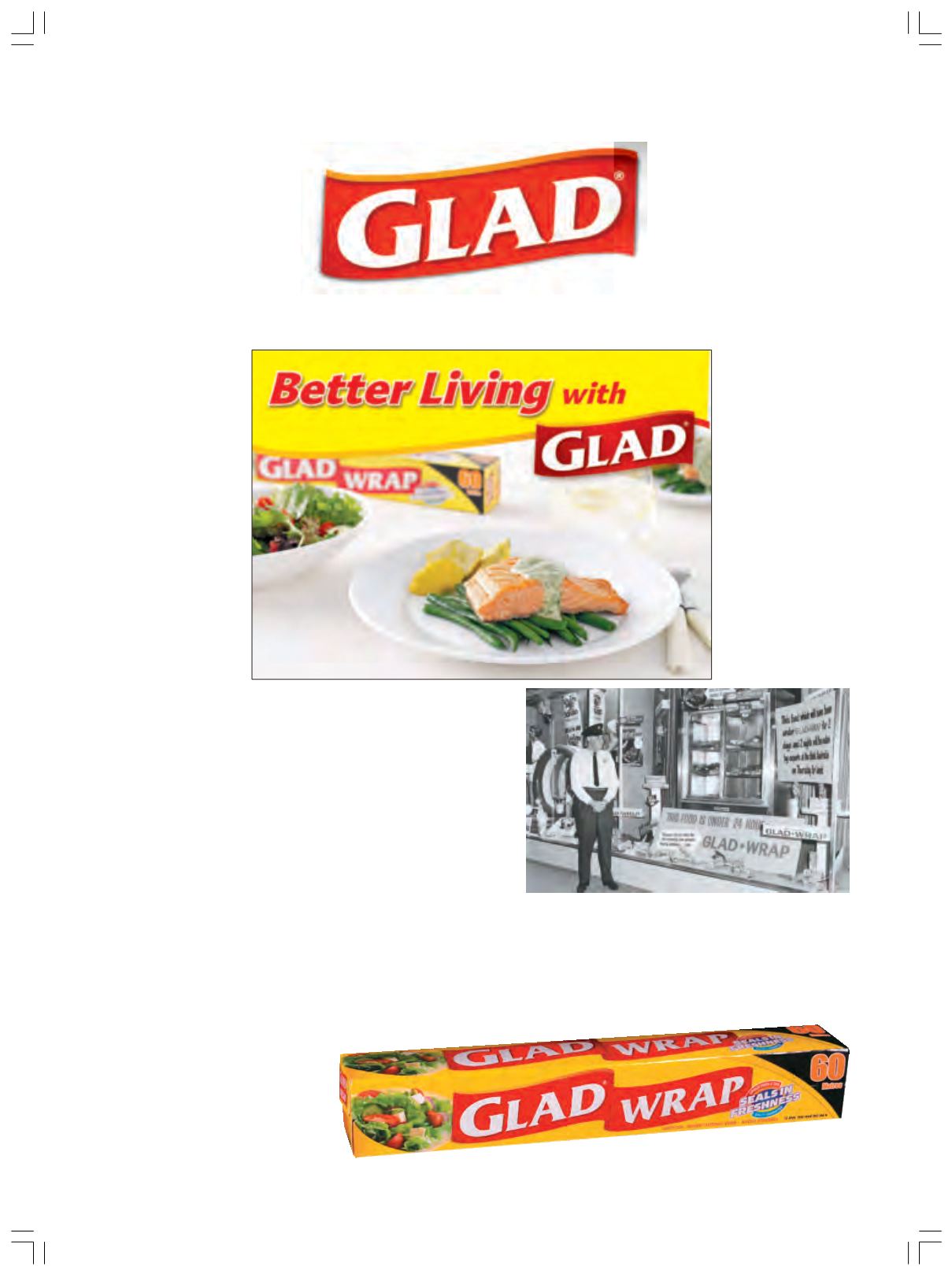
was kept under armed guard
for three days. For a little
extra pizzazz, it was stored in
glass door refrigerators in the
main
windows
of
Woolworths’George andPitt
Street stores in Sydney and
in the main window of GJ
Coles Bourke Street store in
Melbourne. When the food
was unwrapped, the guests
were amazed to find that this
new plastic wrapping
actually kept food as fresh
as it had been before it was
wrapped.
This spectacular and highly successful launch
ofGLADWrapandGLADFoodBagswas followed
by the introduction of Garbage and Kitchen Tidy
Bags in the early 1970s andGLADAluminiumFoil
andGLADBake Paper products in the early 1980s.
By 1997, theGLADproduct range totalsmore than
60 individual pack sizes.
52
052-053_glad.p65
10/22/2007, 3:09 PM
52