


 108 / 154

THE MARKET
Tariff reductions and Free Trade
Agreements, the rise of China as a
manufacturing giant, and the power
of the Internet to provide access
to global markets, have all had an
enormous impact on Australian
industry. Our manufacturers now
have towork harder and smarter to
stay ahead.
Research conducted for the
Australian Made, Australian
Grown Campaign has consistently
shown that Australian consumers
prefer to buy Australian products.
In addition, research carried out
overseas indicates that much of the
world has an appetite for things
Australian.
The Campaign’s key objectives
are to assist consumers to exercise their preference
for buying Australian, and to give Australian
producers and manufacturers a competitive edge
by clearly and consistently branding products with
an instantly recognisable and trusted symbol of
Australia.
ACHIEVEMENTS
The latest Roy Morgan research shows that the
logo is recognised by 98% of Australians and is
the most trusted identifier for Australian goods.
Even with the restructuring of the manufacturing
sector, the campaign continues to grow with more
than 400 new licensees in 2006/07.
The campaign’s support forAustralian furniture
manufacturerswas recognisedwhenmajor retailers
Harvey Norman Furniture and Bedding, Forty
Winks and Bev Marks Australia came on board as
campaign partners.
The strength of the campaign was
acknowledged in 2007 when the Department of
Agriculture, Fisheries and Forestry agreed to use
the Campaign as the delivery vehicle and the logo
as the centrepiece of its new food labelling
initiative, ‘AustralianGrown’.
HISTORY
The origins of the Australian
Made, Australian Grown
Campaign date back to shortly
after Federation when the merits
of buying Australian made were
advocated inFederal Parliament. In
the 1930s, various chambers of
manufactures championed the cause of buying
Australian in publications and press
advertisements.
A national campaign known as Operation
Boomerangwas launched in 1961 by theAssociated
Chambers of Manufactures of Australia. The aim
of Operation Boomerang was to raise the profile of
Australian manufacturing and encourage people
to buy locally made goods. The logo for the
campaign – a red boomerang on a blue
background with the Southern Cross – can
still be seen on some of our older buildings
and shop signage today.
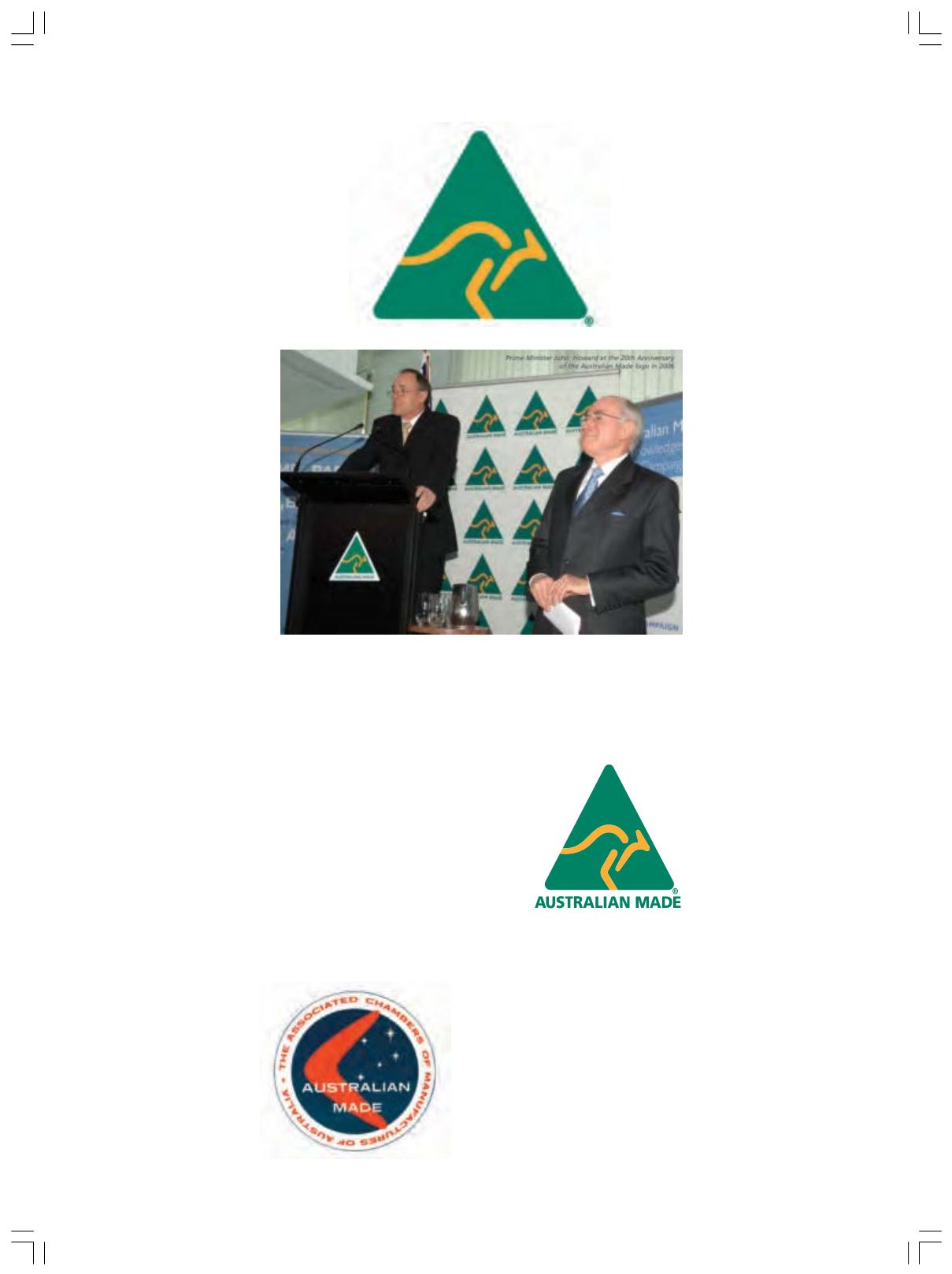
In 1986, a new logowas developed.
Commissioned by the Australian
Government, the green and gold
Australian Made logo was
designed by Melbourne graphic
designer Ken Cato and featured
a stylised kangaroowithin a triangle. TheAustralian
Made Campaign was launched by then Prime
Minister Bob Hawke in Melbourne.
The scheme was administered by the Advance
Australia Foundation and attracted a
significant number of users who paid
a licence fee for the right to use the
logo on their products. However,
in 1996, the Foundationwent into
voluntary liquidation, and the
logo reverted to the Australian
Government. Existing licensees
were givenpermission to continue
using the logo until new
arrangements were put into place.
During 1997 and 1998, the
AustralianChamber of Commerce
and Industry (ACCI) took the lead
in re-launching the logo, with an
industry consultation process
which led to the development of a
new Code of Practice and
administrative structure. On 1 July
1999 the Australian Made
Campaign resumed with a new
company - Australian Made
Campaign Limited (AMCL) – as
the approved certifier of users of
the Australian Made logo. PM
John Howard officially launched
the new campaign in September of
that year.
The Code of Practice set out
criteria for goods which were
consistent with the country of
origin provisions of the Trade Practices Act 1974
as amended in 1998. In order to be eligible to carry
the logo, goods had to be “substantially
transformed” inAustralia, and 50% or more of the
cost of producing or manufacturing the goods had
to be attributable to production or manufacturing
processes that occurred in Australia.
In May 2007 the rules governing the use of
the logowere varied to allow its use with fresh
and packaged produce, and Australian
Grownwas born.
THE PRODUCT
The Australian Made, Australian
Grown logo is available to any
person or organisation whose
products meet the compliance
criteria in the Code of Practice.
Potential licensees must
complete an application form, listing those
products, and pay an annual licence fee. Licence
fees are based on turnover and range from $275 to
$22,000.
Licensees are granted the right to use the logo
on products and promotional material. The
‘Directory’ section of the Australian Made,
Australian Grown website lists all licensees and
products. Licensees can create their ownweb pages
with information about their company and products.
Every licensee receives a free listing in the annual
publication, “Consumer Guide to Buying
Australian”, which is distributed free to consumers
through supermarkets and other outlets.
18
018-019_aust made.p65
10/20/2007, 9:39 PM
18