


 133 / 154

THE MARKET
Mambo was launched in 1984 into an industry that
was entirely focused on the production of a surf-
specific product. It was an industry that had grown
rich selling a “dream” and as a result had become
very exclusive. It was also an industry that in
Mambo’s opinion “took itself far too seriously”.
Mambo decided that in
addition to producing
clothing it would sharewith
themarket its passion for art,
humour, music and politics.
In so doing, it became one of the first
brands to move out of the surf-
specific market and into the more
eclectic, surf and streetwear market
where it continues to operate today.
While Mambo is
situatedmainly in the youth
clothing and textile area,
their development of several
related product categories
has enabled them to build very active
and successful relationships with the
skiwear, footwear, optical, sunglasses,
watch and surf hardware markets.
ACHIEVEMENTS
Over the past 23 years, Mambo has become one of
Australia’s best known brands. In 2006, Principle
(an Australian research company) named Mambo
as ‘Australia’s sixth most authentic brand’, in a list
that included brands such as Bonds, Speedo, RM
Williams andBillabong.
Because Mambo evolved out of a large and
successful screenprinting business (Phantom
Textile Printers) there was no financial pressure on
the company to conform to the usual demands of
the surf and streetwear industry. As a result,
Mambo could afford to ignore market convention
and offer a product that was in no way typical of
that being produced at the time. This made it easier
for the consumer to decide what they liked instead
of having the retail industry
making that decision for them.
And that decision has often
been made easier by
Mambo’s use of strong
graphics and often self-
deprecating humour. These two
facets
of
Mambo’s
personality have also led
to a change inmarket
expectation, acting as
a catalyst to expand the parameters of what was
once a very one dimensional industry.
HISTORY
Mambo was launched by Dare Jennings in 1984,
“in a nice pair of boardshorts and a fashionably
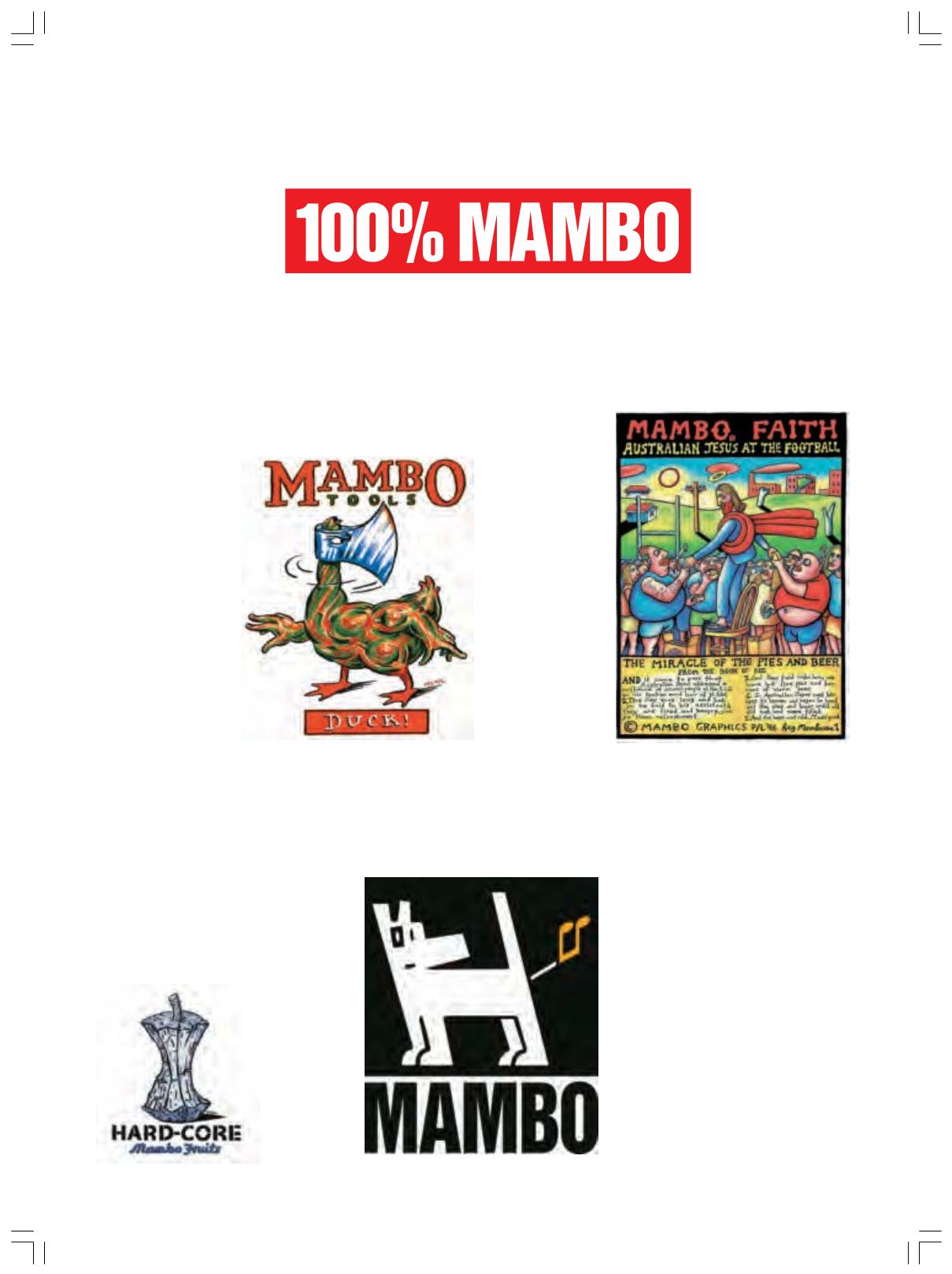
oversized t-shirt”. Their classic ‘FartingDog’ t-shirt
was released in 1987 and is
possibly one of the most
recognisable
t-shirt
graphics on the planet.
While Mambo produces a
wide range of surf and street related
products they remain first and foremost, a
surfwear label. But Mambo is not
like other surf labels. Their
passion for surfing represents
just one aspect of amuch richer
life. Unlike the major brands,
selling surfing as a religion,
Mambo lives in a much
biggerworld. That world is
defined by their passion for “surf
& art & music & love & life &
death & football & just about the
whole damned thing”. By their
own admission, Mambo is a
fiercely independent company and has never
pandered to the whims of the surf and streetwear
market.
Art has played a pivotal part in the company’s
development. Over the past 23 years Mambo has
worked with many well-known Australian and
overseas artists includingRegMombassa (guitarist
andoriginalmember ofAustralian rockband,Mental
As Anything), Richard Allan, Robert Moore, Josh
Petherick, PaulMcNeil,BenFrost,BeciOrpin,Maria
Kozic, and David McKay plus, Mark Falls and
Robert Williams (US), Trevor Jackson (UK) and
Rockin’Jelly Bean andTomooGokita (Japan).
In 1993Mambowas invited by theArt Gallery of
NSWto sharewall space along side an international
exhibition of Surrealist art. The following year they
released, ‘Art Irritates Life’, the first of three books.
The release coincided with the launch of an
exhibition of original Mambo artwork at the
Northern Territory Museum and Art Gallery in
Darwin. The show, which included paintings,
original t-shirt graphics, posters, surfboards,
ceramics, rugs and pinball machines, drew record
crowds. As a result of that success the exhibition
travelled to several other state and regional
galleries. Mambo has also had exhibitions in
London, Bologna (Italy) and in Sydney, at the
Museum of Contemporary Art (MCA) and Ray
HughesGallery.
The first Mambo ‘Loud Shirt’, a not too distant
cousin of the famous ‘Hawaiian’ shirt, was released
in 1994. ‘Blue Hawaii’ by Martin Plaza (another
member ofMentalAsAnything), became an instant
hit and led to the creation of a style that has since
become a “classic” (and also very collectible) not
only in Australia but also throughout Europe and
the UK.
To cope with a steadily increasing demand for
66
066-067_mambo.p65
10/25/2007, 7:45 PM
66