


 143 / 154

THE MARKET
The razor blade market in Australia is currently
valued at approximately $198million split between
replaceable razor blades ($106m), disposable razors
($65m) and razors ($25m).
The past few decades have seen some fairly
dramatic technological changes in the wet shaving
market. In the early1960s themarketwas dominated
by carbon steel double blades, slowly replaced by
stainless steel towards the end of the decade. The
1970s saw the first systems products evolve and
the introduction of the disposable razor. The first
half of the 1980s was the era of the disposable as
they became widely available in all forms - single
blade, twin blade, fixed and swivel heads. Since
then, the systems razors have benefited immensely
from technological advances. Razor handles
designed specifically for women have been
introduced, as well as lubricating strips, guard bars
and an increasing number of blades all attempting
to deliver a closer, more comfortable shave.
ACHIEVEMENTS
One of the most noteworthy accomplishments of
the Schick Shaving Products Group was the
development of a one-push cleaning feature to aid
in removing debris from between blades. Clean
blades last longer and provide a closer shave.
Many razor systems
produced by the Schick
Shaving Products Group
have a comfort or lubricating
strip located on the cap
above the blades. Warner
Lambert originally patented
this improvement to the daily
shave. These strips, some of
which contain aloe, aremade
fromwater-soluble polymer.
When activated by water
they provide lubrication that
makes the shave more
comfortable.
Another
approach to the same end is
used on many products, in
which an aquaglide strip is
positioned on the cartridge
cap. When wet, the strip
becomes extremely slippery
and reduces the friction
between skin and blade.
These innovative materials
are safe to the consumer and
effective in improving
shaving comfort.
In an effort to develop an extremely safe shaving
system the twin blades in some products are
wrapped with very thin wire. Patented Microfine
Wire Wraps protect the skin from nicks, cuts and
irritation while providing the closeness the shaver
needs.
Another major development in shaving is the
flexible cartridge.Asophisticated design and special
materials allow the blades to flex to the contours of
the area being shaved. The innovative flexing action
of the twin blade cartridges shaves like no other
system and conforms to the unique shape of every
face.
Schick’s entry into the women’s blade market
was in 1995with the SchickSilkEffects forWomen
Razor. This razor has patented micro-fine wires
wrapped around twin blades which make getting a
closer shave gentler on your skin. The razor was
the first designed specifically to meet women’s
needs - not just an adaptation of a man’s razor.
Since then Schick has continued to launch
innovative new shaving solutions into thewomen’s
wet shave market and their differentiated portfolio
of products has seen them recently become the
market leaders within women’s razors in the
Australianmarket (Aztec scan dataMAT19/8/07).
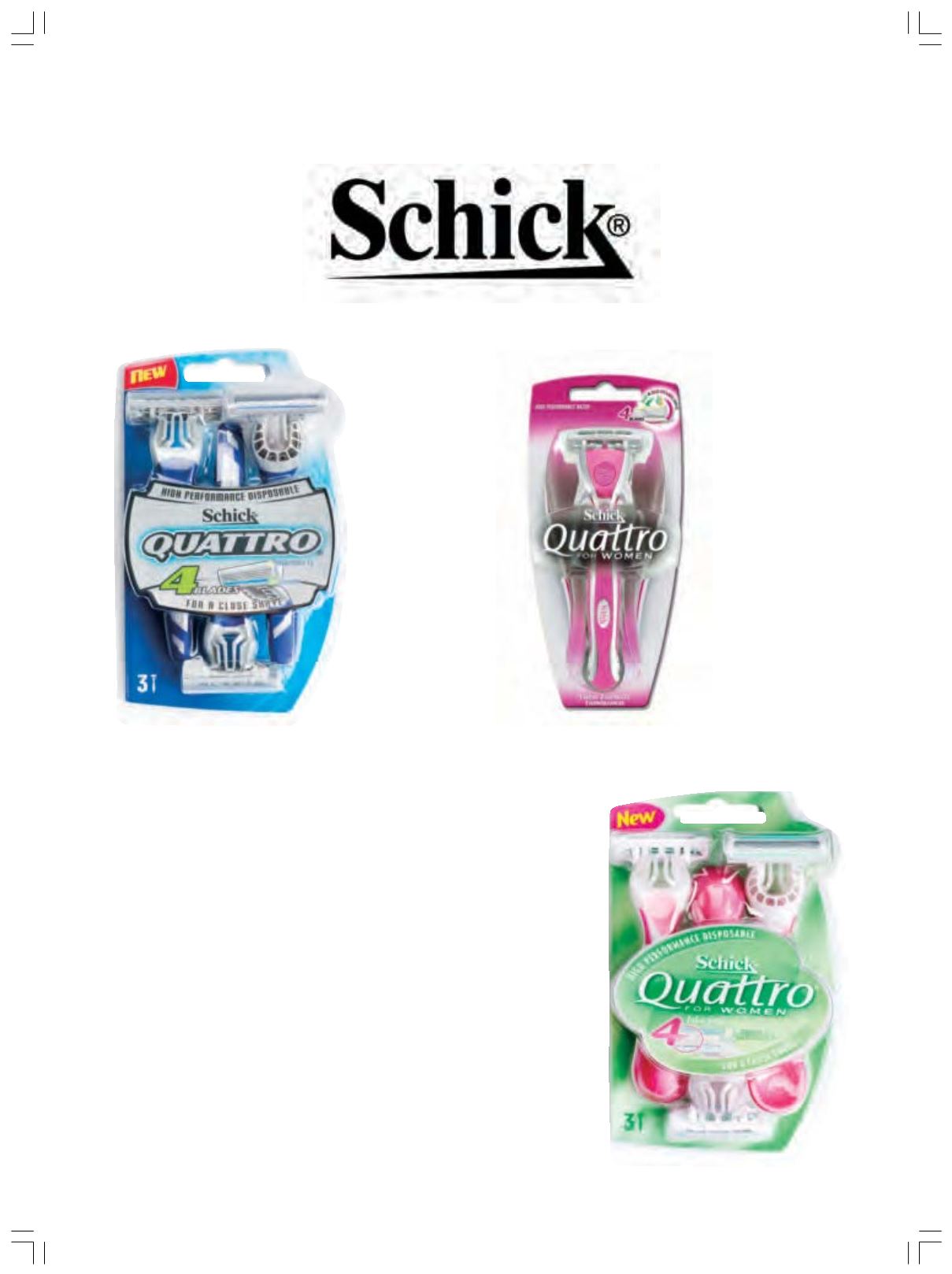
Schick has been first tomarket with a number of
products: the first triple
bladed disposable, the
Xtreme3; the first all-in-one
women’s shaving system,
Intuition; as well as the first
four-bladed razor, Quattro.
The Xtreme3 disposable is
currently the number one
selling disposable brand.
HISTORY
Schick traces its origins to the
inventiveUSArmyLieutenant
Colonel Jacob Schick. He
retiredfromthemilitaryin1910
but then returned to service
at the start of World War I. In
1921, inspired by the army
repeating rifle, Colonel Schick
invented a new type of safety
razor - the Magazine
Repeating Razor. It had
replacement blades stored in
the handle ready to be fed into
shaving position without the
chore and danger of handling
a sharp blade. Production of this innovative razor
started in Jersey City in 1926. These razors were
the forerunners to the famous Injector Razor. In
1927, Schick sold all his interest in the Magazine
90
090-091_Schick.p65
10/21/2007, 5:59 AM
90